MP vows to fight Green Belt building plans
The government announced new planning reforms that could see more homes built on Shropshire’s Green Belt. Wrekin MP Mark Pritchard spoke out in the House of Commons against the changes, which were unveiled by the Housing Minister just before the Christmas recess.
The reforms, introduced by Housing and Planning Minister Matthew Pennycook, include a “default yes” for developments near railway stations. The plans also focus on the “densification” of urban and suburban areas to meet national housing targets.
The planning reforms announced this week introduce a “default yes” for new housing across the Wrekin and Shropshire to tackle the national housing crisis. These rules aim to speed up building on land that was previously protected, particularly around transport links.
The “default yes” policy applies to any land within the catchment area of “well-connected” railway stations. To qualify, a station must have more than two trains per hour in any one direction. Under these rules, developments can take place even on land currently designated as Green Belt.
Higher density requirements
New standards have been set for the density of these developments to ensure land is used effectively. Proposals near any railway station must include at least 40 dwellings per hectare. For the most well-connected hubs, this requirement rises to 50 dwellings per hectare.
The government is also introducing “brownfield passports” for urban areas like Telford. This makes development on suitable urban land acceptable by default, assuming it meets basic safety and design standards.
Limits on local powers
Councils will find it harder to block larger projects under the new framework. Planning authorities must now notify the government if they intend to refuse any application for 150 homes or more. This allows the Housing Secretary to “call in” the decision and potentially overrule local councillors.
Smaller sites have also been targeted for faster approval. Developments on sites up to 0.2 hectares will be exempt from biodiversity net gain requirements, which previously required developers to improve the natural environment on-site.
The “Grey Belt” and Golden Rules
For Green Belt land that is not near a station, the government has created a new “Grey Belt” category. This includes previously developed land or sites that do not “strongly contribute” to the traditional purposes of the Green Belt, such as preventing towns from merging.
Building on this land comes with strict “Golden Rules” for developers:
- At least 50% of the homes must be affordable housing.
- Developers must pay for necessary infrastructure, such as schools and GP surgeries.
- Public access to green space must be improved as part of the project.
These measures are intended to unlock land for a potential 1.8 million homes across the country by removing what the Minister described as “haphazard” local restrictions.
Local areas at risk
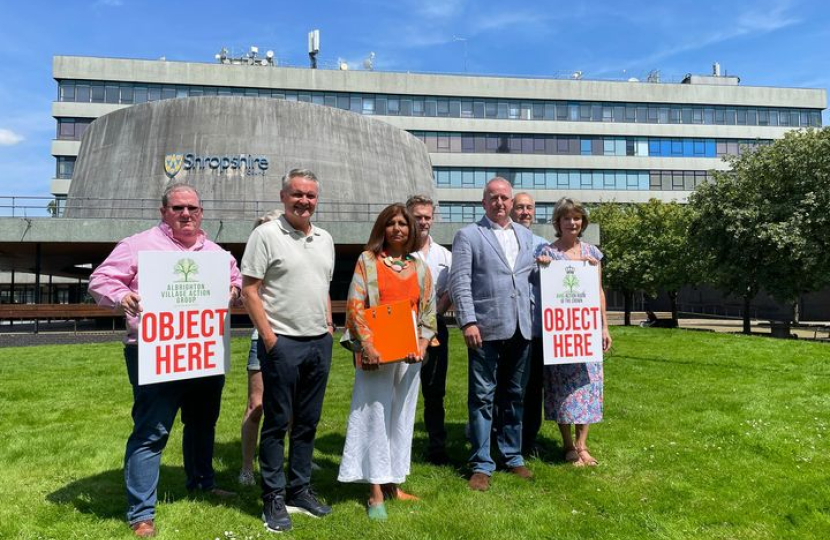
Mr Pritchard described the announcement as a “dark day” for the county. He highlighted several areas at risk, including Albrighton, Shifnal, and parts of the Telford and Wrekin borough such as Edgmond, Bratton, and Church Aston.
During the session, the MP questioned if more could be done to bring empty social housing properties, known as voids, back into use. He suggested this approach would take the pressure off local green spaces.
Minister responds to concerns
The Minister responded by stating that councils already have significant powers to deal with empty homes. He noted that his priority is the 1.3 million people currently on social housing waiting lists.
Mr Pennycook added that building more homes requires the development of both brownfield and Green Belt land. He pointed to the 170,000 children currently living in temporary accommodation as a key reason for the policy shift.
“My concern is less about the instances he described and more about the 1.3 million people languishing on social housing waiting lists,” the Minister told the House.
Standing firm
Following the exchange, Mr Pritchard insisted that while he is not against housing, it must be built in the right place and at the right scale. He expressed strong opposition to the use of Green Belt land for these projects.
The MP said: “The government is now shamelessly and openly saying they want to bulldoze Shropshire’s Green Belt to deliver its top-down housing targets. I will fight these plans all the way.”